Yukon Energy made numerous alterations to an invoice from its legal counsel, and got paid based on the altered invoice. This much is clear. But should YEC be paid based on an altered invoice? In filing an expense claim, is it ok to alter your receipts? Or is that criminal?
The question is, are these alterations “material changes” that would make this a “false document” under Canadian Criminal Code?
After thorough refusal to review the full evidence, the Yukon Utilities Board has concluded that… it is ok to alter an invoice, making such changes as covering the first two letters of “irrelevant” to make it into “relevant”, with customers paying the price for things that are “relevant”. Is this a material change? Certainly changing “irrelevant” into “relevant” does change the meaning and the result, at least in my opinion.
There are plenty of other examples in the document, such as covering “AEY” (ATCO) to make items look as though costs are part of the YEC GRA when they are not. In this posting, I’ll look primarily at “irrelevant” / “relevant” example, as this is the easiest one. Other examples can be found in this newer posting with links to all of the relevant documents.
YEC redacted the document by putting white boxes over words or parts of words, and sent out the PDF file, forgetting that the original document was still searchable and accessible in the electronic version submitted to the Utilities Board.
—-
This is a summary of a public cost claim comment submitted to the Yukon Utilities Board, noting what appears to be an unsuccessfully redacted document from Yukon Energy, and asking if it is acceptable to make these kinds of alterations to an invoice. I don’t know the answer, but felt it was worth asking. All of the documents cited are publicly available on the YUB website. Look for YEC’s cost claim near the bottom.
Here’s an example from YEC’s cost claim for the 2023-24 GRA.

This is probably the easiest example of what I am talking about. Only things relevant to the GRA can be charged on a cost claim. Certainly this appears to be relevant? But what is that white box doing there? Could it be covering something that might change the meaning? Maybe like this?

In the cost claim that YEC submitted, certain words or parts of words were redacted, and this appears to have changed the meaning. The redaction method used did not fully obscure text that was covered up in this invoice from its legal counsel, as the original text was still accessible under the white boxes, and can be found in searches, copied and pasted and easily revealed. Opening YEC’s cost claim in a graphics program and changing the boxes to 100% transparency gives the result above.
From the Supreme Court of Canada website instructions on redacting a document:
Ensure that the text you do not want revealed is not in fact still in the PDF file. In a properly redacted document, the purpose of blacking text out is to indicate clearly that text has been deleted and to show readers the location and extent of the deletion.
An attempt to redact text will be unsuccessful if sensitive content is blocked using a method that merely covers up the text so that it is no longer visible on the screen, but that allows readers to access the content by copying and pasting.
So I’m thinking this was an unsuccessful attempt to redact a document. White boxes covering things up, but the original text still accessible. The question here:
Is it ok for YEC to alter an invoice submitted in a cost claim, for example changing “irrelevant” into “relevant” with customers then charged for this irrelevant work?
The Scale of Costs from the Yukon Utilities Board is clear that costs need to be “necessarily related to the proceeding”. I’m taking that as meaning relevant to the proceeding.
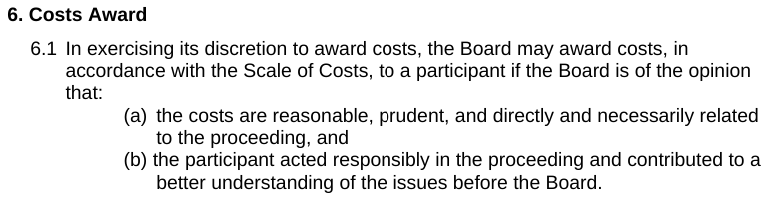
So I’m thinking that “irrelevant to GRA” is not related to the proceeding – but then YEC covered up the first two letters to make it “relevant to GRA” Is it ok to do this? Or is this what could be called a “material alteration”?
The following is taken from my cost claim comment submitted in the proceeding after comparing the original invoice with the redacted version, both inadvertently submitted by YEC.
So Is it OK to alter invoices from subcontractors in order to get paid more? While it might not seem to be a big thing for YEC to charge ratepayers for a few extra hours – or even 78.5 extra hours at $350/hr, there is a bigger issue here. More significant than the amounts involved, is YEC’s knowingly presenting altered documents to the Board in this cost claim.
An invoice was materially altered to make work that was irrelevant to the GRA appear to be relevant to the GRA, and this was submitted to the Board.
So I am asking, did YEC knowingly present a materially altered document to the Yukon Utilities Board?
In Section 366 of Canadian Criminal Code, under the heading of “Forgery” we find “Making false document”.
Do (a) and (c) apply?
Making false document
366(2) Making a false document includes
(a) altering a genuine document in any material part;
(b) making a material addition to a genuine document or adding to it a false date,
attestation, seal or other thing that is material; or
(c) making a material alteration in a genuine document by erasure, obliteration,
removal or in any other way.
So… The Utilities Board has been asked to consider if the changes made are “material alterations”. I am not a lawyer, but to me, if that is what occurred, changing “irrelevant” to “relevant” seems like a material alteration? It does appear to change the meaning and the result.
And there are other examples. Is it ok to charge for work on the AEY (ATCO) GRA to the YEC GRA? If not, why did YEC in some cases remove “AEY” from the invoice giving the impression that the work was for the YEC GRA.

Where the unredacted invoice shows:

So why did YEC choose to redact this? More examples are provided in the cost claim comment.
My understanding is that if these are material alterations, this makes YEC's cost claim a false document. If it is determined to be a false document, the Yukon Utilities Board will have to toss it out and customers will not be charged for the amount of the cost claim. This is because Canadian Criminal Code 368(1)(a), notes that the Board cannot use, deal with or act on YEC's cost claim as if it were genuine IF the Board knows or believes that there are material alterations. So my goal is for the Board to look at the redacted view AND the unredacted view to determine if this is a false document. So far, the Board has refused to look at the unredacted view - which I think could make the Board "know or believe" that YEC has submitted a false document.
YEC submitted the redacted and unredacted versions to the Utilites Board in the same document, with the redaction being "unsuccessful" exactly as described on the Supreme Court's web page. The unredacted page views were sent to the Utilities Board, and the Board replied "... In fact, we have deleted them from our server. Neither has the Board reviewed them." Why is the Board not willing to view the full content of what YEC submitted in a public hearing? If the unredacted view is not reviewed by the Board, the Board will not "know or believe" that it is a false document, but also might not be able to say that it is a genuine document?
And what is the current status of the unredacted view? It has been sent to the Yukon Utilities Board again (and they say deleted again), and also the the Department of Justice. Ask them for a copy? Or better yet, make your own by making the white boxes transparent. I have sent simple instructions to the Board on how to do this, and allowing them to confirm the redacted text they received from YEC for themselves.
Documents submitted to the Utilities Board are supposed to be public I think? The unredacted view was submitted as part of my cost claim comment, but was deleted and not made public as noted above, though anyone can view it with a minute or two of work after downloading YEC's Cost Claim from the Yukon Utilities Board website - linked below. I think the Board should take a closer look at the document. It is after all, on the public record. If you would like to look without doing any work here is a link to the unredacted pages.
And again, if the Utilities Board reviews the full public record, YEC's cost claim for $599,601.76 may have to be rejected in its entirety, and these costs will NOT then be charged to customers. Or if these redactions are reasonable, the Board should be able to provide a reasonable explanation as this level of transparency is needed in public hearings. I do hope they look at the evidence presented.
Documents concerning the issue:
YEC's Cost Claim - What YEC submitted, from the Utilities Board site. On the surface redacted, but hidden text is searchable and can be copied and pasted, etc. Download it and search on "irrelevant" and see where you end up. Select and copy the full line of text including the white box and paste into an empty document and what do you find? This works on any of the white boxes in the document. To make all the boxes transparent, open in a graphics editor, select a box and change transparency to 100%. Yes, we could use a little more transparency here. Oh, and if the document has been removed from the YUB website above, it was archived here.
Cost Claim Comment - Noting the redacted info and asking some questions.
The unredacted pages that I submitted with the above and that the Board has refused to review.
Canadian Criminal Code. See 366(2) and 368(1)
And if anyone wants to investigate further, more documents can be provided.
Update: Yukon Utilities Board Decision (May 2025)
The Yukon Utilities Board has now ruled on this issue. In its May 2025 cost award decision, the Board rejected concerns that Yukon Energy submitted “false documents” by altering invoices from its legal counsel. The Board said it routinely accepts redacted invoices and does not inquire into why text is redacted, noting that it may involve legal privilege.
See no evil: In its decision, without looking beneath those white boxes, the Board found no evidence the redactions were improper. (That is, without looking at the evidence presented, the Board found no evidence.) The reasoning appears to be that the Board claims it couldn’t review the hidden text (the evidence) because it might be privileged information, despite the fact that anyone with a computer can download the same public file from the Board’s website and see what’s under the boxes. Can text really be privileged when YEC and the Board have made it available to the public? YEC has not weighed in, and has not claimed for example that the first two letters of "irrelevant" is privileged information. The Utilities Board sees a white box over the first two letters of "irrelevant" and just sees "relevant", because whatever is under the box (in this case "ir") could be sensitive and privileged information. Or so they seem to be saying in the decision?
The Board also stated that Yukon Energy “did not submit” the unredacted text, which is an interesting position, considering the unredacted version sits quietly underneath the white boxes in the same PDF that YEC filed and anyone can download. I can see that maybe YEC didn't mean to submit the unredacted text and had meant to do a better job redacting it, but YEC did submit it.
So... According to the Board, it couldn’t look under the white boxes because the text might be privileged, while also claiming YEC “did not submit” that same text. So which is it? Privileged material the Board can’t see, or material that doesn’t exist? All taken together at face value, the Board is saying it is potentially privileged information but not from YEC. This seems a bit contradictory and circular to me, and I question the validity of both statements, since the information was submitted by YEC and is viewable by the public. As a member of the public, should I feel privileged to have seen information that the Board cannot see?
The Board further ruled that questions about “false documents” and Criminal Code provisions are outside the scope of a cost proceeding. It emphasized that it awards costs under its Scale of Costs, which, true enough, says nothing about respecting the Criminal Code or charging customers for possibly altered invoices. So... Does this mean that Criminal Code is "irrelevant" to Board proceedings? Hmmm... And if Criminal Code does not apply, why did the Board go to such effort to avoid viewing the unredacted information?
Anyway, that’s how it rolls here. The Board didn’t look at documents submitted to the public record, YEC got paid, and customers picked up the tab. If you want to look, here's what YEC covered, and what anyone can uncover.
The Board addressed the issue in paragraph 53 of Board Order 2025-11.
The full decision is available on the Utilities Board website, as Appendix A of Board Order 2025-11.
I wonder.... If my energy bill says $235, can I put a white box over the "2" and pay $35 instead? Hmm...
Disclaimer:
This post summarizes and comments on publicly available filings before the Yukon Utilities Board. It represents my personal opinion and interpretation of the documents. You are encouraged to review the original materials on the YUB website yourself. No allegation of wrongdoing is intended against any individual or organization in this blog posting. I do however hope that questions are answered. It is curious that the Board has refused to look at a document submitted to the public record - and spent more time saying why if couldn't look at a few pages than it would have taken to look at the pages. If any of this offends you, please take a white sheet of paper and use it to cover the offending text.